Almost every week, a woman sits with us holding a scan report and one sentence ringing in her ears: “You have fibroids.”
And almost every week, she has been told one of two extremes — either “it is nothing, don’t worry” or “we need to operate immediately.” Both answers, given without context, do her a disservice.
The truth sits in the middle, and it depends on details most women are never told.
What Fibroids Actually Are
Fibroids are non-cancerous growths of muscle and fibrous tissue that develop in or around the womb. They are extremely common — the NHS estimates that around one in three women develop them at some point, and they are more common, often larger, and often earlier-appearing in women of African descent.
Common does not mean unimportant. But it does mean that having a fibroid is not, on its own, a fertility diagnosis.
The Detail That Matters Most: Location
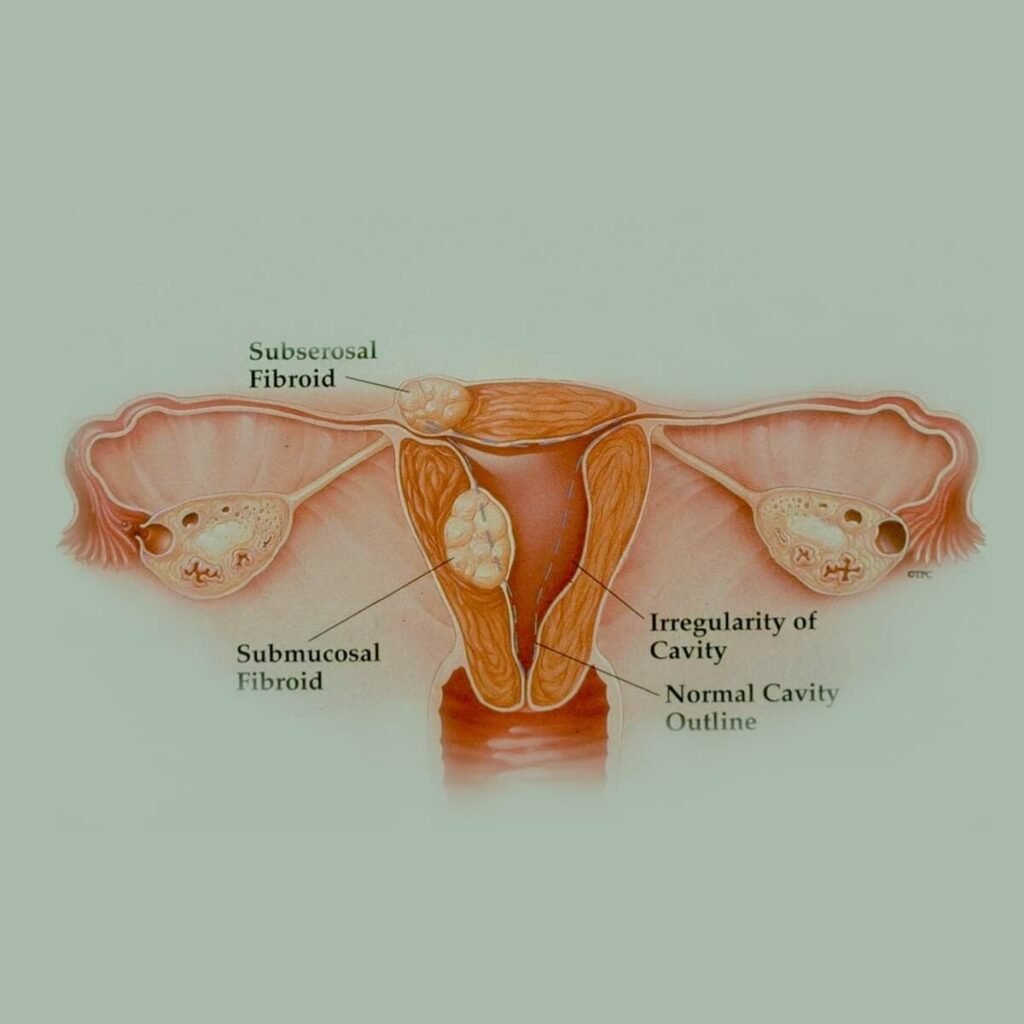
Size gets all the attention. Location matters more. Three positions, three very different stories:
- Submucosal — growing into the cavity of the womb, where an embryo needs to implant. These are the ones most consistently linked to implantation failure and recurrent miscarriage, even when they are small.
- Intramural — growing inside the muscular wall. These may or may not matter, depending on size and whether they distort the cavity.
- Subserosal — growing outward, on the outer surface of the womb. These can become large and cause pressure symptoms, but often have little effect on conception itself.
This is why a 2cm fibroid can be a genuine obstacle while an 8cm one may not be. If your report does not state the location, you do not yet have the information you need — and you are entitled to ask for it. We wrote about exactly this in Why Aren’t You Asking to See Your Own Results?.
How Fibroids Interfere With Conception
- They distort the shape of the uterine cavity, so an embryo cannot implant properly.
- They block the openings of the fallopian tubes, preventing sperm and egg from meeting.
- They alter blood flow to the womb lining, making it less receptive.
- They cause heavy bleeding that leads to anaemia — which affects your whole system, not only your cycle.
Heavy, flooding periods and clots are one of the most common ways fibroids first announce themselves. If that is your experience, read The Colour of Your Period Blood Is Telling You Something and Adenomyosis — The Condition Hiding Behind Your Heavy Periods, because fibroids and adenomyosis are frequently confused with one another and sometimes exist together.
Three Questions to Ask Before Anyone Operates
- Where exactly is it? Submucosal, intramural, or subserosal — and does it distort the cavity?
- Is it actually causing my symptoms? Heavy bleeding and pain have several possible causes. Fibroids are visible on a scan, so they get blamed for everything — sometimes wrongly.
- What happens to my womb if we operate? Myomectomy is real surgery on the organ you are hoping to carry a baby in, and it can leave scarring. It is sometimes absolutely the right decision — but it should be a decision, not a reflex.
Our Approach
At Ohemaa Fertile Home, we do not treat a scan report. We treat the woman holding it. That means understanding your cycle, your bleeding pattern, your pain, your hormone picture and your history — and then supporting the body with targeted herbal care aimed at easing bleeding, reducing inflammation, and improving the environment of the womb.
Where surgery is genuinely needed, we will say so plainly, and we will help you prepare for it and recover well afterwards. What we will not do is tell you a fibroid is nothing when it is quietly standing between you and a pregnancy — or push you toward theatre for a growth that was never the problem.
If you have been told you have fibroids and nobody has explained what that means for you specifically, come and speak with us. Bring your scan report.
Related Reading
At Ohemaa Fertile Home, we provide guided herbal fertility support rooted in three generations of traditional knowledge. We serve women across Ghana, Nigeria, and the diaspora. Reach out to us on WhatsApp for a free, confidential consultation.