A woman told us recently that she had been trying for four years. Four years of counting to day fourteen, timing intercourse, and waiting.
Nobody had ever confirmed that she was ovulating at all.
This is one of the most common gaps we see. Couples spend years perfecting the timing of something that may not be happening — and no amount of perfect timing helps if no egg is released.
A Period Is Not Proof of Ovulation
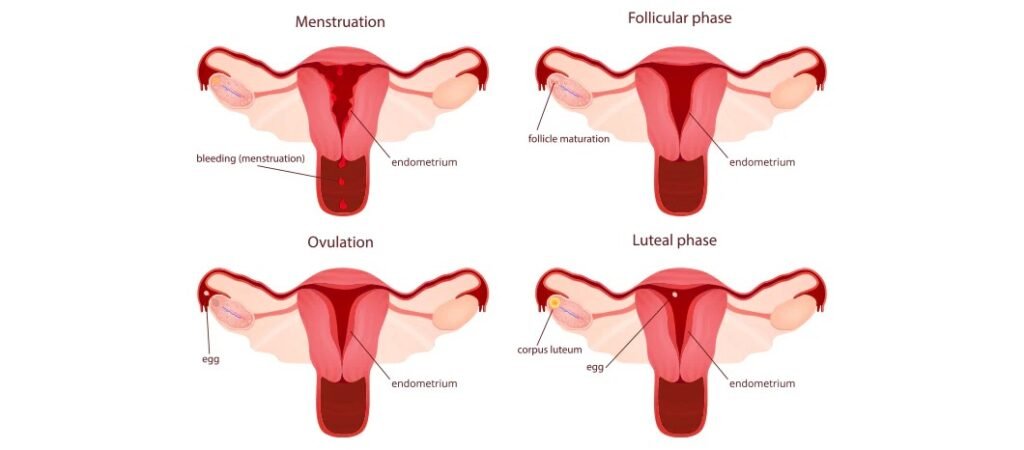
You can bleed monthly without ovulating. It is called an anovulatory cycle, and the bleeding comes from the lining breaking down rather than from a completed cycle. Cycles like this are common with PCOS, with thyroid disorders, under sustained stress, after significant weight change, and in the years approaching menopause.
So “your periods are regular, so you must be fine” is not the reassurance it sounds like.
Day 14 Is an Average, Not a Rule
The famous “day 14” comes from a textbook 28-day cycle. Real cycles vary widely. What stays more consistent is the second half: the luteal phase after ovulation usually runs 12–14 days. So in a 32-day cycle, ovulation is nearer day 18. In a 25-day cycle, nearer day 11.
Counting to 14 in a 32-day cycle means aiming four days early, every single month, for years.
Signs That Predict Ovulation
- Cervical mucus — as ovulation approaches, discharge becomes clear, slippery and stretchy, like raw egg white. This is the single most useful free sign, and it tells you the fertile window is open now.
- Ovulation predictor kits (LH strips) — these detect the hormone surge that triggers release, usually 24–36 hours ahead. Useful, but note that women with PCOS can get repeated positives without ovulating.
- Mittelschmerz — a one-sided twinge or ache mid-cycle. Some women feel it clearly; many feel nothing at all, and that is normal.
- Light spotting — we covered this in Spotting During Ovulation — Is It Normal?.
Signs That Confirm Ovulation Happened
- Basal body temperature (BBT) — a sustained rise of roughly 0.3°C after ovulation, driven by progesterone. Taken every morning before you get out of bed. It confirms afterwards; it does not predict.
- Day 21 progesterone — the test that settles the question. Progesterone is only produced in meaningful amounts after an egg has been released, so a raised level is proof that it happened.
Get the Timing of the Day-21 Test Right
It is called “day 21” because that is 7 days after ovulation in a 28-day cycle. The real instruction is: test 7 days before your period is due. In a 35-day cycle that is day 28, not day 21 — and a day-21 test in a 35-day cycle will come back low and be misread as “you are not ovulating.” We have met women who carried that wrong label for years.
What to Do With What You Learn
Track your actual cycle for three months — first day of bleeding, cycle length, mucus changes. Then have progesterone tested at the right point in your cycle, not a generic one. The NHS guidance on regular intercourse across the fertile window still holds: every 2–3 days through the middle of your cycle covers you without turning your marriage into a schedule.
And if the answer turns out to be that you are not ovulating consistently — that is not bad news. That is a finding, and findings can be worked with. What cannot be worked with is four more years of guessing. Please do not lose that time; waiting is the most expensive decision on this journey.
Book a consultation and let us map your real cycle rather than a textbook one.
Related Reading
At Ohemaa Fertile Home, we provide guided herbal fertility support rooted in three generations of traditional knowledge. We serve women across Ghana, Nigeria, and the diaspora. Reach out to us on WhatsApp for a free, confidential consultation.